The Platform is one of the most thought-provoking films I’ve watched to date. For real. The literature embedded in this film is so good that it left me obsessed with each and every detail of the film. Well, I have some takeaways and theories which I’m DYING to talk about desperately. Nerdy fact: I watched the film twice to see if I missed anything out, that’s how intensely passionate I am about this film. Major spoilers ahead, you have been warned.
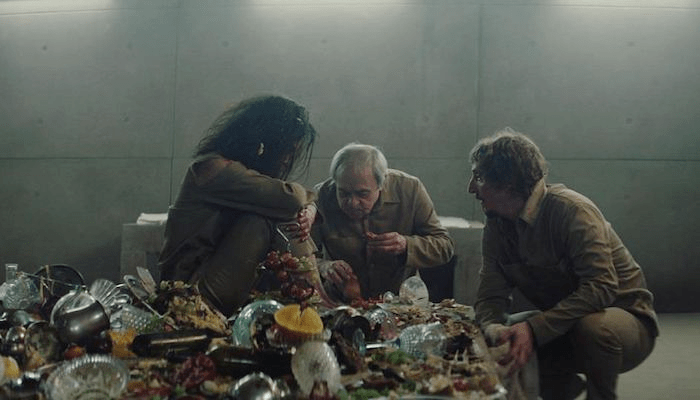
The film uses the prison feeding system to truly portray the capitalistic nature of the world we live in. This is seen when prisoners on Level 1 gets to eat the spread of food first (i.e the rich) and slowly as the platform of food descends down the levels, it depletes and it resulted in the poorest of the poor from level 250 onward not getting any food at all.
We take things for granted.
Feeling unjust about how the capitalistic feeding system works in ‘the Hole’, Goreng tried to engage the people on the level beneath him to spur a change to the “system” which was frowned upon by Trimagasi. He explained that they should not bother with them as they are literally beneath them in status and should not concern themselves with them.
Despite being in the Hole for almost a year, Trimagasi refused to interact with people beneath him knowing full well that he was once in their position. This scene reminded us how often people took things for granted at every opportunity.
We are selfish and entitled.
Goreng also considered engaging the people above on Level 47 but Trimagasi told him that the people above them will not listen to him simply because they don’t have to. They are “better-off”. This is exactly the how the rich behave towards the less “well-off”. There was also this scene where this guy said he deserves to eat because he is on Level 40+ and his cellmate chimed in and said he is entitled to eat because he was one of the bottom feeders the previous month. Its almost astonishing how quick they forgot that they were once at the bottom and didn’t spare a thought for those at the who ended at the bottom that month.
At different phases of our lives, our motivations change.
Everyone who entered the Hole was asked to bring an item with them. Goreng brought a book. Tamagasi brought a knife. Imoguiri brought her dog. Quite possibly, Miharu brought her daughter. Maybe she was pregnant and she didn’t have a choice. We will never know.
Point is, our motivations can change throughout our life. It could be pursuing knowledge, raising children, caring for pets and gathering material possessions (self-sharpening knives, cash).
We discriminate.
When Baharat reached out to the people on Level 5, they questioned his beliefs; whether he believed in the same God as them and if so they would offer to help him. This is eerily similar to our reality where people start wars simply because of discrimination. We discriminate against beliefs that are different from our own. My god is better than yours. Appalling but true.
I like to think that the director also used a black guy as the second male lead for the sole reason of highlighting the discrimination of race as well. The discrimination that exists against black people in our society. Ingenious really.
Life is fair and unpredictable.
The random assignment of cellmates every month. Tamagasi told Goreng to pray for a good level the following month because neither of them knows where they will end up next. This concept draws parallel to the circle of life.
All of us do not have a say whether we get to be born into the riches or the poor. We can simply pray and make do with what life hands us. It also suggests that life itself can be unpredictable. You could be bathing in riches one day and the next scrapping to make ends meet.
We assign blame to others for the mistakes we make.
When Trimagasi and Goreng woke up on Level 171, Trimagasi was prepared to feed on Goreng’s flesh to survive. Right before he starts harming Goreng, he reasoned that the people on the levels above are to blame for his actions. When Goreng told him that he blamed Trimagasi and him only for what he was about to do, it was to highlight that we have the tendency to assign blame to others when it comes to our mistakes.
However, no one is to blame but the perpetrator himself who acted upon his own will. This is further reinforced when Trimagasi attempted to eat the pages off the book he brought. Instead of making excuses, he tried to find solutions to get out extreme circumstance without going against his conscience.
Enforcement to create change.
When Goreng and Baharat ventured to ration out the food, they armed themselves to fight the people who might attempt to eat when they are not supposed to or eat more than what they rationed. The act of creating change requires enforcement. The wise man did mention that reason and logic should be the first choice of weapon. If that doesn’t work, only then violence is used as the last resort. Quite similar to how governance in our society works, its sole aim is to make sure that the needy gets all the help they need and everyone has a part to play to make that happen.
Stay humble.
As they approached the lower levels, the rations reduced significantly to just a small piece of meat and yet the prisoners were amply satisfied. They didn’t fight for more but rather thanked the two gentlemen wholeheartedly with everything they got. For instance, this one guy gave them him cash as a gesture of appreciation. Clearly, generosity is more rampant amongst the needy compared to the rich.
Panna Cotta is the message.
The original message was the Panna Cotta. When they wanted to deliver the Panna Cotta back to the Administration, it was to announce to them that the prisoners broke the “machinery” or rather the capitalistic system built in place and everyone got their fair share of food in the Hole to the extent that there was even a Panna Cotta dish left.
Panna Cotta has to be in perfect condition.
Perfection has been emphasized throughout the film when they focus on the precision and attention to detail for all the dishes they prepare to be placed on the platform. For instance, the Chefs on Level 0 was so anal about perfection that when they found strand of hair in the Panna Cotta, they were bent on investigating who the strand of hair belongs to.
It was vital that the Panna Cotta gets returned in perfect condition to speak to the Chefs in their language of perfection and most importantly convey to the Administration that the prisoners did not behave like vile animals as they might have assumed them to be. We do not destroy everything we touch.
A mother’s instinct rules all.
My theory is that Miharu did indeed have a child living in the Hole. There were allegations by the prisoners that her missing child was a boy but this rumor was deemed false when we later found out that the child at the lowest level was a girl.
Probably this has to do with a mother’s instinct to protect her child and create a reputation amongst prisoners so that no questions will be asked. Quite possibly Miharu has always known that her child was at the lowest level and she has been descending down to the platform to ensure that her child is fed no matter what. In order not to raise any questions, she had to create a persona that creates fear for other prisoners to stay away from her. Coincidentally, she happens to be an actress. What are the odds.
The ending of the film left many questions hanging. Why was there a child in the Hole? Why was she in the lowest level? Why was she alone? What was the significance of her being in the lowest level? And most importantly, why is the child the message?
Why is there a child in the Hole?
The child was hidden by her mother Miharu and she has always been on Level 333. Miharu has been the one keeping her alive *mother’s instinct to protect her young explained earlier*
Why was she at the lowest floor?
Given that Miharu might end up in a different level every month, the common level that she can access easily would be the lowest level -333. So unassumingly, that would be the perfect place to hide her child. And what’s more, no one would think to venture further down into the hole knowing full well of the violence and extreme conditions the prisoners there have to undergo. So the saying goes, “the most dangerous place is also the safest place to be”.
Why was she alone?
By being alone, it emphasizes on the helplessness of children. Unlike the murderers and killers with weapons in the higher levels, children are defenseless and all the more it was pertinent that the child remains alone in that level.
What was the significance of her being in the lowest level?
Throughout the film, people on the upper levels have committed suicide because they have too much free time and nothing to look forward to. Also, murders are rampant due to the extreme circumstances on the lower levels as well.
Assuming the bodies all pile at the bottom of the pit, the child is inherently the one watching all these deaths unfold right in front of her eyes and hence she was hiding in fear underneath her bed when Goreng found her. This is how she sees the world through her eyes.
The child was a better message than the Panna Cotta.
The Hole was never meant to be a place for children and the fact that they found her there shows that not only did they overcome the capitalistic system built in place, they also managed to save what could have been the most innocent victims of this system.
Most importantly, the child as a message serves to remind us that every single action we make has consequences and the most innocent and defenseless victims are the children involved.
We can’t protect them forever.
Goreng wanted to accompany the girl up to the Administration because he was fearful that it may be unsafe for her. This is similar to how parents are protective of their children as they are afraid that they may get into harm’s way when they enter this world. This subtly draws back to the idea of a mother’s instinct to protect her child as well.
When Tamagasi told Goreng that he didn’t need to be the bearer for the girl, he was trying to imply that she can face this world alone and perhaps affirming that Goreng has sparked a positive change that allows her to enter the world fearlessly.
Be the change.
Eventually when they send her back up on the platform to the Administration, she is able to overcome the capitalistic system in the Hole. Personally, I felt that the main message of the movie was to tell us to be the change. Be the change that is necessary to ensure that there is still hope for the future generations to come.
The significance of the level number 333 which the girl was found symbolizes aid and encouragement. Another hint that with a little help from everyone, the future is encouraging and there is still hope.
Every scene in this film tells a story.
Every scene in this film has a story to tell and that’s what makes it so good. My personal favorite is how they portray the concept of perception throughout this film. Perception is conveyed as how things are seen through one’s eyes. In fact, I noticed there are quite a few scenes (including the first scene) that focus on the opening of eyes, specifically Goreng’s eyes. It emphasizes on the world that he sees as is.
Personally, it is quite subtle but I like how the ending scene when Goreng descends into the dark pit, it sort of draws a similarity to someone closing their eyes and having the light rays disappear. It signify closure. It could imply that Goreng could have passed away from his injuries. This ties up the film nicely from the beginning (opening his eyes) to the end (closing his eyes). His perception is has changed after this experience and perhaps he has made a positive change to the world he came into as well. Subtle but so good.
Rating 11/10
Go. Watch. it. Now.
 theniecextn.
Leave a comment